Active-Active and Active-Passive Clusters
The two most commonly used architectures for high availability (HA) clustering configurations are as follow:
- Active-Active
- Active-Passive
Active-Active
An active-active cluster is typically made up of at least two nodes actively running the same kind of service simultaneously. The primary purpose of an active-active cluster is to achieve load balancing. Load balancing distributes workloads across all nodes to prevent any single node from getting overloaded. Because more nodes are available to serve, there will also be a marked improvement in throughput and response times.
Usecase: It Uses this failover configuration when you want all of your resources to be available most of the time. When a resource becomes unavailable, Route 53 can detect that it’s unhealthy and stop including it when responding to queries.
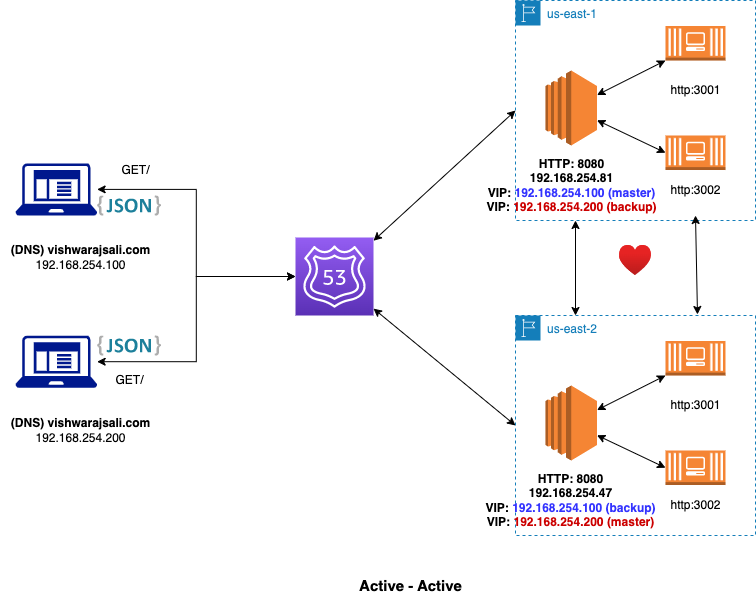
Fail over: When one server goes down, the other server will serve all the requests. For example, in the above diagram, when Server us-east-2 fails, server us-east-1 would serve the requests.
Active-Passive
An active-active cluster is typically made up of at least two nodes, both actively running the same kind of service simultaneously. The primary purpose of an active-active cluster is to achieve load balancing. Load balancing distributes workloads across all nodes to prevent any single node from getting overloaded. Because more nodes are available to serve, there will also be a marked improvement in throughput and response times.
Usecase: Use an active-passive failover configuration when you want a primary resource or group of resources to be available the majority of the time, and you want a secondary resource or group of resources to be on standby in case all the primary resources become unavailable.
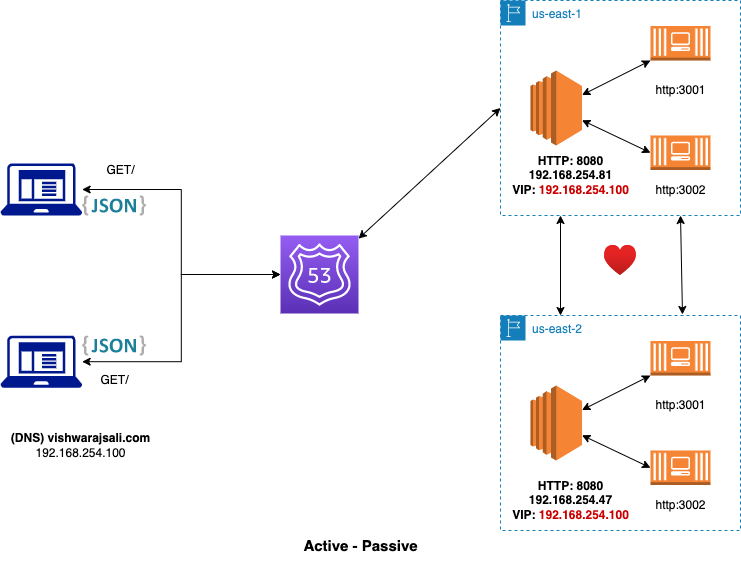
Fail over: When the primary server (us-east-1) goes down, the second server(us-east-2) would come online and start serving the requests.
Difference between Active-Active and Active-Passive
| Active-Active | Active-Passive |
|---|---|
| Number Of servers online in a happy day scenario < Number of servers online in a fail over scenario. | Number Of servers online in a happy day scenario = Number of servers online in a fail over scenario. |
| System performance suffers during fail over | 1System performance remains same during fail over |
Advantages
Four key advantages of cluster computing are as follows:
- High availability
- Scalability
- Performance
- Cost-effective
Implementations
Load balancers could be configured to work either in Active-Active or in Active-Passive configurations. Active-Active or Active-Passive configuration could be used as a general design principle in System design.